


Welcome to the thrilling world of go-karting! Whether you are a complete novice preparing for your first session or a budding enthusiast aiming to shave precious seconds off your lap time, you have come to the right place. Go-karting is more than just pressing a pedal to the floor; it is a fantastic test of skill, strategy, and precision that serves as the training ground for many professional racing drivers. It also makes for an incredibly fun and unique gift for the thrill-seeker in your life, offering an adrenaline rush that is hard to beat.
At Guess What I Did, we know a thing or two about memorable experiences, and go-karting is a firm favourite for good reason. This guide is packed with actionable tips for go karting that will help you move beyond the basics and feel confident on the circuit. We will cover everything you need to know to get started and improve your performance, from finding the perfect racing line and mastering smooth control to understanding race etiquette and preparing properly for the day. Our goal is to provide you with the essential knowledge needed to conquer the track, stay safe, and maybe even find yourself standing on top of the podium
1. Prepare for Your Day at the Track Like a Pro
Your go-karting experience starts well before you fasten your helmet. Proper preparation is the foundation of a safe, comfortable, and thrilling day at the track, allowing you to focus entirely on your driving. This initial step is one of the most crucial tips for go karting because it directly influences your performance and enjoyment.
What to Wear for Maximum Comfort and Safety
Your choice of clothing is more than a fashion statement; it's a practical decision that impacts your race. Loose items like scarves, long necklaces, or baggy hoodies are a serious safety hazard and are universally banned from tracks. Instead, opt for comfortable, close-fitting attire that allows for a full range of movement.
- Tops: A long-sleeved t-shirt or a thin, zip-up jacket is ideal. This protects your arms from any minor scrapes and provides a comfortable layer under the mandatory race suit.
- Trousers: Wear comfortable jeans or athletic trousers. Avoid shorts, as your legs need to be fully covered.
- Footwear: Sturdy, closed-toe shoes are essential. Trainers or other flat-soled shoes provide the best pedal control and protection. Absolutely no sandals, flip-flops, or high heels are permitted.
Assembling the Perfect "Race Day Kit"
If you're organising a go-karting day as a gift, you can elevate the experience by creating a themed 'race day kit'. This thoughtful touch turns a fun activity into a memorable event.
Pro Tip: A 'race day kit' shows you've thought about every detail. Include items like a pair of racing gloves for better grip, a balaclava for hygiene under the helmet, a water bottle for hydration, and perhaps a novelty winner's medal to present at the end.
Selecting Your Circuit
Not all tracks are created equal. Researching the venue is a key part of your preparation. Some circuits, like the outdoor tracks available through www.guesswhatidid.co.uk, offer high-speed straights and challenging corners perfect for adrenaline seekers. Indoor tracks, conversely, often feature tighter, more technical layouts that test driver precision. Consider the skill level of your group and what kind of experience you're after when booking. By planning ahead, you ensure the day is perfectly tailored to your ambitions on the track.
2. Master Smooth Steering and Control
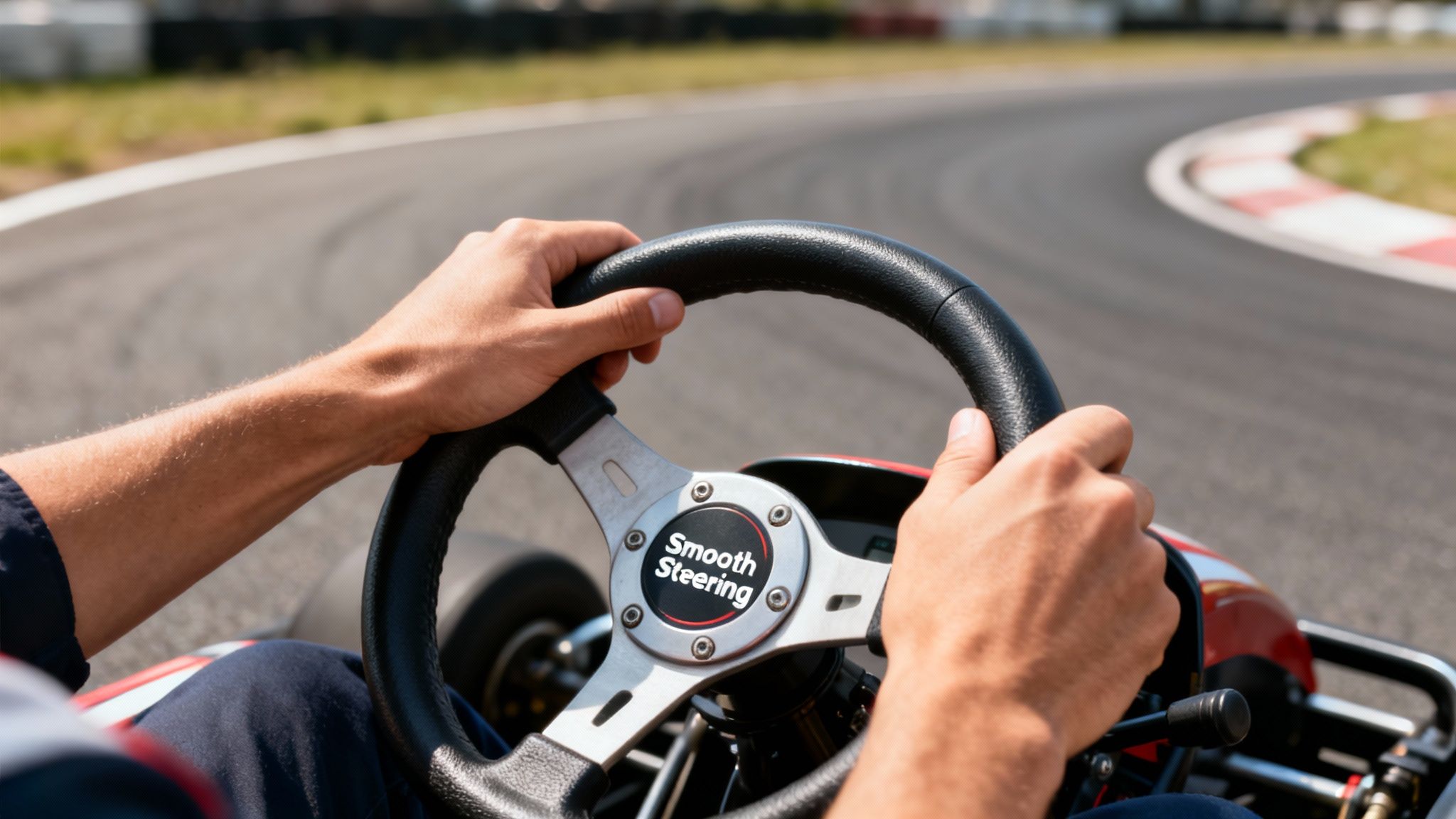
Once you're settled in the kart, your primary connection to the track is the steering wheel. How you handle it dictates everything from your cornering speed to your lap times. Go-karts are incredibly responsive, meaning that jerky, aggressive steering movements will unsettle the chassis, scrub off speed, and wear out your tyres. Mastering smooth control is one of the most fundamental tips for go karting, separating the novices from the racers.
Why Smooth Inputs Are Everything
Unlike a regular car, a go-kart has no suspension and a very direct steering rack. Every tiny input you make is transferred directly to the wheels. Sudden, sharp turns cause the tyres to lose traction, resulting in a slide (understeer or oversteer) that costs you precious time. The goal is to be deliberate and fluid, turning the wheel just enough to navigate the corner efficiently. This principle of smooth control is the same foundation that professional drivers use, even when they get behind the wheel of a high-performance Aston Martin, where precision is key.
Actionable Techniques for Better Steering
Putting smooth steering into practice involves conscious effort and focus. It’s not just about turning the wheel; it’s about feeling how the kart responds and making precise, calculated adjustments.
- Hand Position: Keep your hands at the "9 and 3 o'clock" positions. This provides maximum leverage and control for precise movements.
- Relax Your Grip: A tight, white-knuckle grip prevents you from feeling the kart's feedback through the wheel. Relax your hands and arms to stay sensitive to what the chassis is doing.
- Look Ahead: Focus your vision far down the track towards the exit of the corner, not directly in front of the kart. Your hands will naturally follow your eyes, leading to smoother, more flowing lines.
- Avoid Over-Correction: If the kart begins to slide, resist the urge to violently turn the wheel in the opposite direction. Small, measured corrections are far more effective at regaining control without losing momentum.
Perfecting Your Control on the Circuit
The best place to develop this skill is on the track itself. Start your laps at a controlled pace, focusing entirely on being as smooth as possible with your steering, braking, and throttle application.
Pro Tip: Think of a piece of string connecting your steering wheel to your pedals. As you turn the wheel more, you should ease off the throttle, and as you straighten the wheel on the corner exit, you can smoothly apply more power. This mental model encourages fluid, coordinated inputs.
By concentrating on smoothness over raw aggression, you'll find your lap times improve dramatically. This controlled approach builds the foundation needed to push the limits safely and consistently, turning a fun drive into a truly competitive performance.
3. Optimize Braking Technique
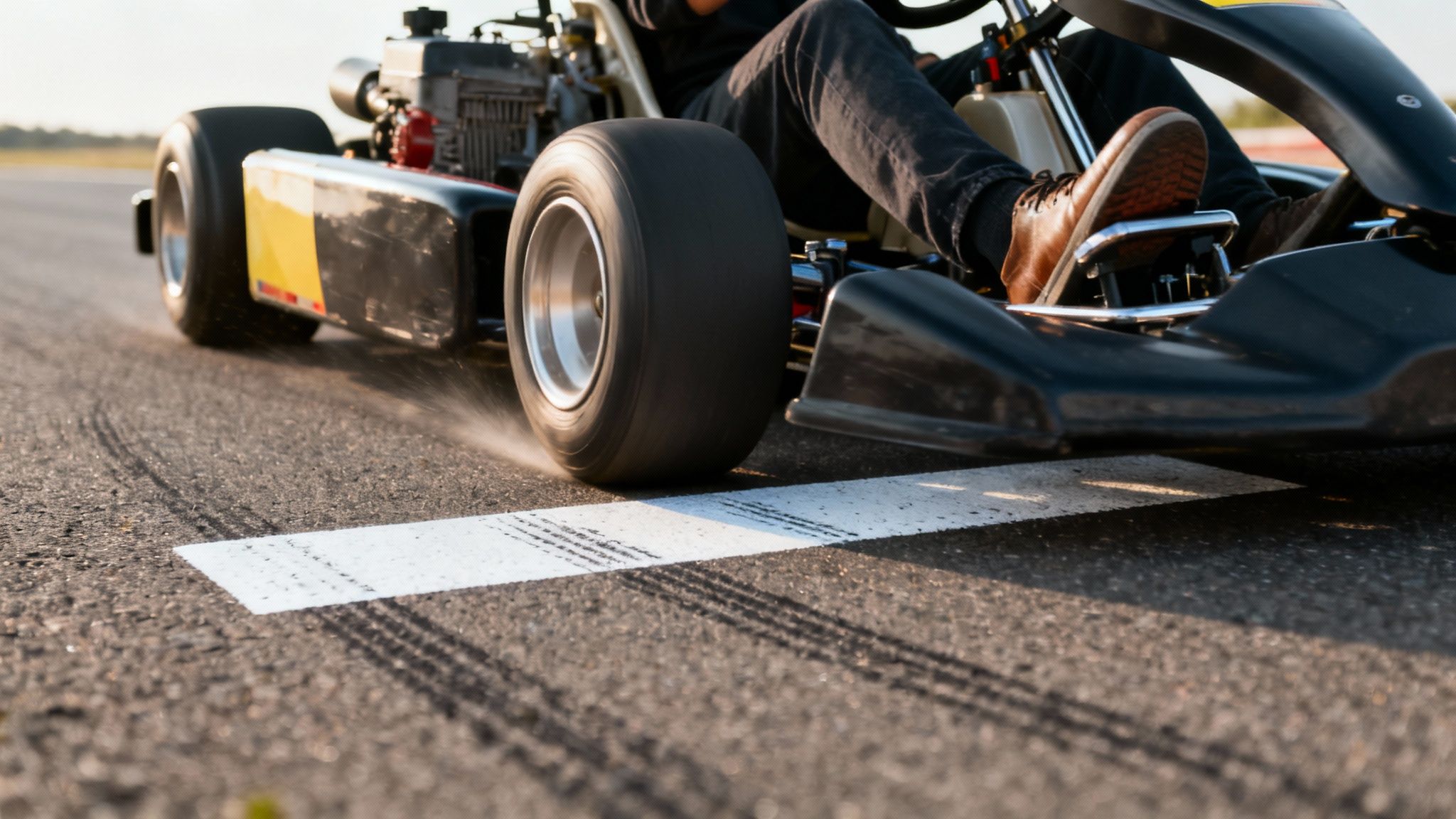
Mastering the art of braking is often the single most significant factor separating novice drivers from the regulars at the top of the leaderboard. It’s not just about slowing down; it’s about controlling your speed to set up the perfect corner entry. This is one of the most impactful tips for go karting because effective braking allows you to carry more speed through the entire circuit, turning lost tenths of a second into a decisive advantage.
How to Brake Like a Professional
The goal is to brake as late and as hard as possible in a straight line, then smoothly release the brake as you begin to turn into the corner. This technique, known as "threshold braking," involves applying maximum brake pressure without locking the wheels, which would cause a skid and a loss of control. Legends of motorsport, like Lewis Hamilton, honed this precise skill in their karting years, learning to feel the absolute limit of grip.
- Brake Markers: Identify a fixed point on the track before each corner (a cone, a mark on the barrier, a change in surface) to use as your consistent braking point.
- Straight-Line Braking: Do all your heavy braking while the kart is travelling straight. Braking hard while turning will unbalance the kart.
- Smooth Release: As you start to turn the steering wheel, gradually ease off the brake pedal. This is called "trail braking" and helps maintain grip at the front tyres, pulling the kart into the apex.
- Avoid Locking Up: If you feel the rear wheels lock and start to slide, slightly reduce the pressure on the pedal to regain traction.
Turning Good Braking into Great Lap Times
Applying these techniques transforms your entire approach to the track. You'll find yourself able to challenge other drivers into corners, confident that you can brake later and still make the turn cleanly. This is where races are often won and lost.
Pro Tip: Don't be afraid to experiment. On a clear lap, try braking a metre or two later than your usual marker. You will quickly discover the kart's limits and build the confidence needed to push them consistently, which is a key step towards improving your lap times.
Finding the Right Track to Practise
Putting these skills to the test requires a circuit with a good mix of corners. The challenging outdoor tracks available through www.guesswhatidid.co.uk provide the perfect environment, with fast straights leading into tight hairpins and flowing chicanes. These varied layouts demand precise brake control, offering the ideal training ground to refine your technique and leave your competition behind.
4. Develop Consistent Throttle Management
Mastering the accelerator is more art than science, separating good drivers from great ones. Throttle management isn't just about pressing a pedal to the floor; it's about the delicate and precise application of power to maintain grip and momentum. This is one of the most technical tips for go karting, as it requires you to develop a feel for the kart's limits and respond with smooth, controlled inputs.
What is Throttle Control and Why Does It Matter?
Unlike your road car, a go-kart has no power steering or advanced traction control. Your right foot is the primary tool for managing the kart's balance and grip. Applying the throttle too aggressively on a corner exit will cause the rear wheels to lose traction, resulting in a slide (oversteer) that scrubs off speed. Being too timid means you're leaving precious tenths of a second on the track. The goal is to apply power progressively, perfectly matching the kart's available grip as you unwind the steering wheel.
- Smoothness is Key: Abrupt inputs upset the kart's balance. Aim for a fluid, gradual application of the throttle as you exit a corner.
- Listen and Feel: Pay attention to the sound of the engine and the feeling through the chassis. A bogging engine means you've applied too much throttle too soon, while a screaming engine with no forward bite means you're spinning the wheels.
- Track Conditions: Adjust your throttle application based on the track surface. A wet or cold track offers less grip, demanding even smoother and more patient throttle control. While understanding weight transfer is key for maximising grip, true proficiency also means mastering driving in adverse conditions that can drastically alter kart handling.
Putting Smooth Acceleration into Practice
Elite drivers in the top tiers of motorsport are renowned for their exceptional throttle consistency. They make it look effortless because they've trained their muscle memory to perfection. You can start building this same skill on your next track day.
Pro Tip: Find a long corner and practice feeding the throttle in gently as you exit. Your aim is to be at full throttle precisely when the steering wheel is straight. If the kart starts to slide, you've been too aggressive; ease off slightly to regain traction and try again.
Honing Your Throttle Technique
Building this skill takes focus and deliberate practice. Start by concentrating on just one or two corners per lap, focusing solely on your throttle application. Once you feel more confident, apply the technique to the entire circuit. By mastering smooth acceleration, you'll not only become faster but also a more controlled and consistent driver, turning every lap into a calculated display of skill.
5. Understand Kart Setup and Maintenance
While arrive-and-drive karting centres manage their fleets, understanding the fundamentals of kart setup and maintenance will give you a significant advantage. A well-configured kart is safer, more responsive, and ultimately faster. This knowledge is one of the most powerful tips for go karting for anyone looking to progress from casual fun to competitive racing, as it unlocks the true performance potential of the machine.
Why Small Adjustments Make a Big Difference
Professional karting teams, like those you see in world championships, spend hours optimising chassis tuning between heats. Even minor adjustments to things like tyre pressure or seat position can dramatically alter how a kart handles, affecting everything from cornering grip to straight-line speed. It’s the difference between fighting the kart around every bend and having it feel like a natural extension of your body.
- Seat Position: Your position dictates the kart's centre of gravity. It must allow you to fully press the pedals without stretching and reach the steering wheel with a comfortable bend in your elbows.
- Tyre Pressure: This is one of the most critical and easiest adjustments. Higher pressure can lead to less grip but faster straight-line speed, while lower pressure often increases cornering grip at the cost of rolling resistance.
- Basic Checks: Even at a recreational level, a quick check of chain tension and brake responsiveness can ensure the kart is operating safely and efficiently.
Putting Knowledge into Practice
For those looking to take their driving more seriously, understanding setup becomes a fascinating part of the sport. It transforms you from a passive driver into an active participant in the kart's performance.
Pro Tip: When you're at the track, ask the mechanics about the karts. Inquire about how they check tyre pressures or how they ensure the brakes are balanced. This curiosity will deepen your understanding and respect for the mechanics of motorsport.
Finding a Venue That Cares
A key element of a great karting experience is the quality of the equipment. Venues that prioritise maintenance offer a safer and more competitive environment, ensuring that driver skill is the main deciding factor in a race. The outdoor circuits available through experiences on www.guesswhatidid.co.uk are known for their well-maintained fleets, giving you confidence that you’re driving a kart that is both safe and capable of performing at its best. By choosing a reputable track, you ensure the foundational aspects of kart setup and maintenance are already handled by experts.
6. Build Mental Toughness and Race Awareness
Go-kart racing is a test of reflexes and skill, but the battle is often won in the mind before it's won on the tarmac. Your mental state is as crucial as your physical control of the kart. Building focus, confidence, and the ability to handle pressure is a game-changing aspect of performance, making this one of the most advanced tips for go karting that separates good drivers from great ones.
The Psychology of Speed
The difference between a fast lap and a slow one often comes down to concentration and composure. Mental toughness allows you to remain calm during intense wheel-to-wheel moments, learn from mistakes without losing confidence, and maintain your focus for an entire race. Race awareness is its counterpart, involving a constant understanding of your competitors' positions and strategies while managing your own performance on the track. Legends like Lewis Hamilton have credited this kind of mental training as a critical component of their early karting success.
- Visualisation: Before the race begins, close your eyes and mentally drive a perfect lap. Visualise hitting every apex, braking at the right moment, and accelerating smoothly out of each corner.
- Routine: Develop a simple pre-race routine, like a few deep breaths or a quick stretch, to signal to your brain that it's time to focus.
- Mistake Management: If you spin out or miss a corner, don't dwell on it. Acknowledge the error and immediately refocus on the next turn. The most important lap is always the one you are on right now.
Turning Theory into Track Performance
Applying these mental strategies can feel abstract, but their impact is tangible. Setting process-oriented goals, such as achieving three smooth corner exits in a row, is more productive than just aiming to win. This approach builds consistency and skill, which naturally leads to better results. Beyond the physical techniques, building your mental game is crucial; learn how to improve mental stamina, focus, and resilience to maintain peak performance throughout your race.
Pro Tip: Keep a small journal of your race experiences. After a session, note down what went well and where you struggled. This practice helps you recognise patterns in your performance and mental state, allowing you to identify areas for improvement for your next day at the track.
Applying Awareness on the Circuit
Race awareness is about looking beyond the kart directly in front of you. Pay attention to the lines other drivers are taking. Are they defending their position? Are they struggling in a particular corner? This information allows you to anticipate overtaking opportunities and avoid potential incidents. By combining this sharp awareness with a calm, focused mindset, you transform from merely driving the kart to truly racing it.
7. Practice Strategic Racing and Overtaking
Driving fast is only half the battle; winning races is about driving smart. Strategic racing and calculated overtaking separate the good drivers from the great ones. This involves more than just raw speed; it’s about understanding the flow of the race, reading your competitors, and executing moves with precision. Mastering this is one of the most advanced tips for go karting and is what makes the sport so endlessly compelling.
How to Plan and Execute a Perfect Pass
Overtaking isn't about diving into every gap you see. It requires planning, patience, and a deep understanding of both your kart's capabilities and your opponent's weaknesses. A well-executed pass is a thing of beauty, often set up several corners in advance.
- Identify Passing Zones: Study the track during your warm-up laps. The best places to overtake are typically at the end of long straights leading into tight corners, or through technical sections where you might have a handling advantage.
- Analyse Your Opponent: Watch the driver ahead. Are they braking early? Do they take a wide line through a particular corner? Identifying their weak points allows you to plan a targeted attack.
- Attack vs. Defend: Know when to be aggressive and when to protect your position. Sometimes, holding a defensive line to keep a faster driver behind you is more valuable than risking a risky overtake on the person in front.
Developing Your "Race Craft"
The art of managing a race, known as "race craft," is a skill developed through practice and observation. It’s the same strategic thinking that professional drivers use, from karting championships right up to the highest echelons of motorsport.
Pro Tip: Don't just focus on the kart directly in front of you. Look several karts ahead to anticipate battles and potential opportunities. A fight between two drivers ahead can slow them both down, creating a perfect window for you to pass them both.
From Karting to Supercars
Learning how to read the track and manage competitors is a foundational skill that applies to all forms of driving. The principles of braking points, cornering lines, and strategic positioning are universal. These skills are not just for the karting track; they are the very same ones you'd use when learning to handle the power of a supercar. By mastering race craft in a go-kart, you're building a solid foundation for any future high-performance driving.
7-Point Go-Karting Tips Comparison
| Technique | Complexity 🔄 | Resources ⚡ | Expected Outcomes ⭐ | Ideal Use Cases 💡 | Key Advantages 📊 |
|---|---|---|---|---|---|
| Perfect Your Racing Line | Medium — requires repeated practice and track study | Low–Medium — track time, video review or coach | High (⭐⭐⭐⭐) — notable lap-time reduction and consistency | Time-trial, heat racing, learning new tracks | Cuts lap time, reduces tire wear, builds consistency |
| Master Smooth Steering and Control | High — fine motor skill and sensitivity to inputs | Low — focused practice sessions; coaching helpful | High (⭐⭐⭐⭐) — improved grip, corner speed and comfort | Technical circuits, beginners developing fundamentals | Better tire life, improved balance, steadier race pace |
| Optimize Braking Technique | High — precise timing and modulation needed | Medium — safe practice areas, brake markers, coaching | Very High (⭐⭐⭐⭐⭐) — enables later braking and more overtakes | Competitive racing, tight braking zones, qualifying runs | Deeper corner entry, faster laps, more passing opportunities |
| Develop Consistent Throttle Management | Medium — requires feel and repetition | Low–Medium — varied practice, different karts/conditions | High (⭐⭐⭐⭐) — smoother exits and consistent lap times | Wet/dry conditions, long stints, consistency training | Maximizes exit speed, prevents oversteer, saves tires/fuel |
| Understand Kart Setup and Maintenance | Medium — technical knowledge and systematic testing | High — tools, parts, workshop time, or professional support | High (⭐⭐⭐⭐) — tailored handling and increased reliability | Team environments, frequent racers, performance tuning | Optimizes handling, safety, and component lifespan |
| Build Mental Toughness & Race Awareness | Medium — long-term psychological skill development | Low — routines, visualization; sports psychologist optional | High (⭐⭐⭐⭐) — steadier performance under pressure | Endurance races, championships, close-field racing | Better focus, strategic decisions, faster recovery from errors |
| Practice Strategic Racing & Overtaking | High — situational judgement and timing required | Medium — race practice, simulations, rule study | High (⭐⭐⭐⭐) — more positions gained, improved race results | Wheel-to-wheel events, championship rounds, aggressive tracks | Increases win probability, develops racecraft, tactical flexibility |
Crossing the Finish Line
You've now navigated the hairpin turns and accelerated through the straights of our essential tips for go karting. The journey from a tentative beginner to a confident track enthusiast is built upon understanding and consistently applying these core principles. It's about more than just pressing the accelerator; it's a dynamic blend of strategy, control, and awareness.
We've covered the critical elements that separate a good lap from a great one. Mastering the racing line isn't just theory; it's the fundamental map to finding speed on any circuit. Likewise, smooth, deliberate inputs with the steering, throttle, and brakes are the language of the kart. Jerky, aggressive movements upset the delicate balance, scrubbing off precious momentum and costing you time. By focusing on consistency, you build a solid foundation upon which to develop your racecraft.
Your Path to the Podium
The most crucial takeaway is that every moment on the track is a learning opportunity. Think of these tips as a toolkit, not a rigid set of rules.
- Initial Focus: On your next outing, concentrate on just one or two techniques. Perhaps dedicate a session entirely to perfecting your braking points or focusing on hitting every apex flawlessly.
- Progressive Skill Building: Once you feel comfortable with the basics, start layering in more advanced concepts like strategic overtaking and developing your race awareness. Notice where other drivers are faster and analyse why.
- Mindset is Key: Remember, mental toughness is just as important as physical skill. Stay calm, focused, and adaptable. A single mistake doesn't define your race; your recovery and resilience do.
Embracing these concepts transforms go-karting from a simple thrill ride into a deeply rewarding and engaging sport. The satisfaction comes not just from the speed, but from the feeling of a perfectly executed corner, a well-timed overtake, and the continuous improvement you see in your lap times. This journey of refinement is what keeps drivers coming back for more.
The chequered flag on this article is just the green light for your own racing adventure. You are now equipped with the knowledge to drive faster, race smarter, and, most importantly, have a fantastic and safe time. The real learning happens on the tarmac, where theory meets reality. Go out there, apply what you've learned, and feel the exhilarating rush of crossing that finish line, knowing you gave it your all.
Ready to put these expert tips into practice and feel the adrenaline for yourself? Guess What I Did offers a fantastic selection of go-karting experiences across the UK, perfect for a thrilling day out or an unforgettable gift. Find your ideal track and book your next racing adventure at Guess What I Did today.